Why This Works Visually
Fruit suspended in clear jelly — the oldest trick in the dessert world
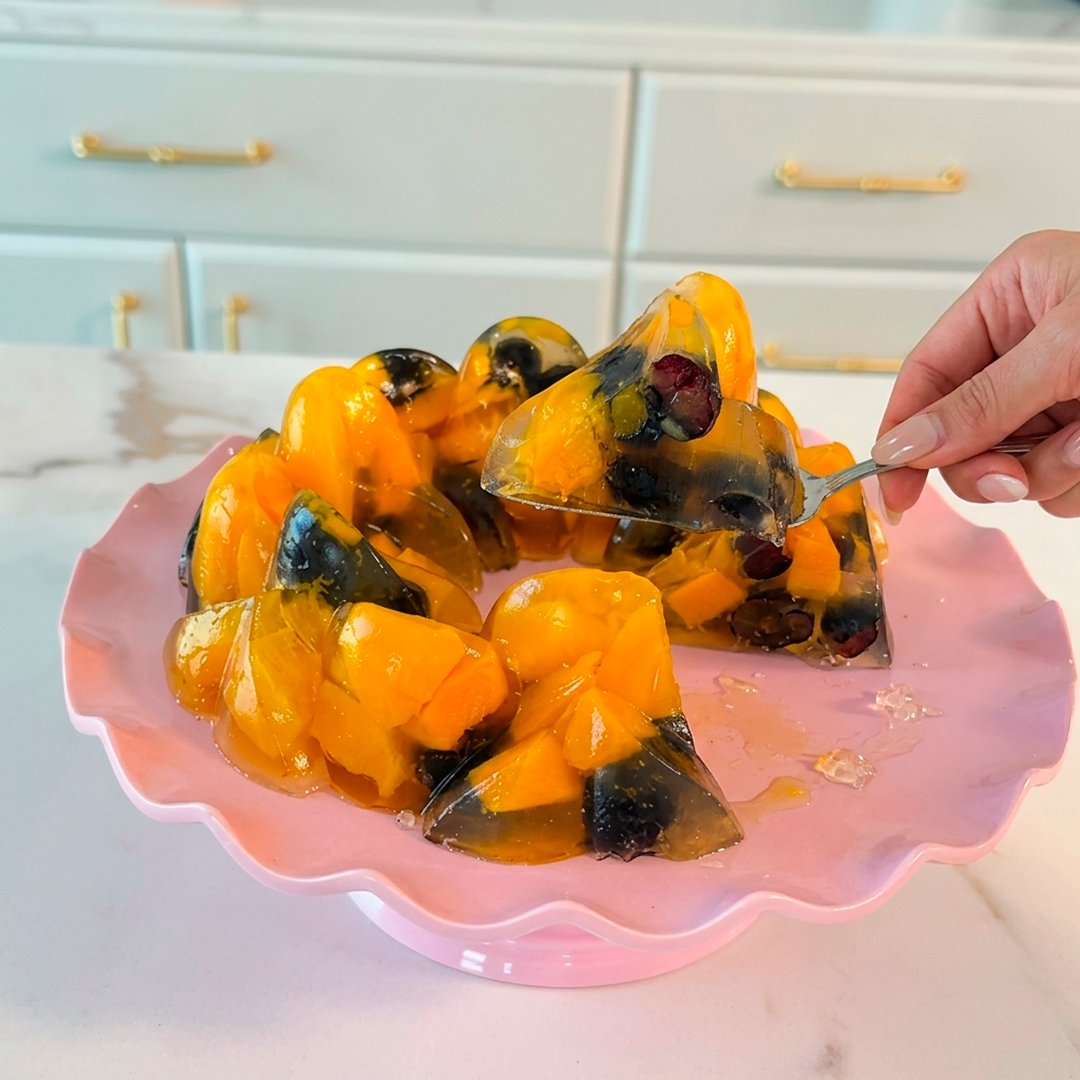
The suspended-fruit jelly technique has been used in formal dessert-making for over a century. What makes it spectacular is the interplay between the clarity of the jelly and the opacity of the fruit: the translucent base allows you to see the fruit from every angle, while the fruit's colour is amplified by the reflective quality of the surrounding gel. In a bundt ring shape, every slice reveals this cross-section — the amber jelly, the orange mango, the deep blue of the blueberries — arranged in a pattern that looks designed rather than poured.
The technique itself is not complicated. What requires precision is the temperature and sequence of the fruit layering — if the jelly is too warm when the fruit is added, the fruit rises or sinks to one side. If it is too cold, the surface of the already-set jelly fails to bond with the new pour. The complete recipe specifies the exact visual test that eliminates guesswork at every stage.
What Goes Inside
Choosing fruit that survives the setting process
🥭
🥭
Mango — the primary fruit
Fresh or frozen mango cut into substantial chunks — not diced small. Large pieces remain visually distinct through the clear jelly and produce better textural contrast in each slice. The orange colour is the dominant visual element in the ring.
🫐
🫐
Blueberries — the counterpoint
Whole blueberries. Their small size means they distribute evenly through the mould rather than clustering. Their deep blue-purple colour provides maximum contrast against both the amber jelly and the orange mango — the visual combination that makes this ring look professional.
✦
✦
What to avoid
Fresh pineapple, kiwi, and papaya all contain enzymes that prevent gelatin from setting. Always use one of these fruits and the jelly will remain liquid regardless of how much gelatin you add. The complete recipe lists all compatible and incompatible fruits.
Mould Selection
The bundt mould — what matters and what doesn't
Mould Selection Guide — What to Look For
Material
Silicone preferred — flexible sides allow the ring to be peeled away from the set jelly without the risk of breaking. Metal bundt pans work well too but require a longer warm-water bath to release cleanly.
Capacity
2–2.5 litre capacity — the recipe is calibrated for this size. Smaller moulds will overfill; larger moulds will produce a thinner ring with less visual impact.
Central tube
Essential — the central tube is what creates the ring shape and the dramatic cross-section when sliced. A standard round mould will not produce the same visual effect.
Oiling
Light neutral oil, applied before filling — even silicone moulds benefit from a light oil coating to ensure clean unmoulding. Spray oil or a pastry brush with neutral-flavoured oil both work.
Plate size
Serving plate must be larger than the mould — the unmoulded ring will be approximately the diameter of the mould's outer edge. Allow at least 5cm of serving space beyond the ring on all sides.
The Method
Five stages — sequence is everything
01
Prepare the jelly base and let it cool
Dissolve unflavoured gelatin in warm water with a small amount of sugar and citric acid for brightness. Allow to cool to approximately 35–40°C — just warm to the touch.
02
Pour a thin base layer into the oiled mould
Pour approximately 1–1.5cm of jelly into the oiled mould. Refrigerate for 20 minutes until the base layer is just firm. This base is what holds the fruit in place in the final presentation.
03
Arrange fruit over the set base layer
Distribute mango chunks and whole blueberries evenly around the ring channel. Press them lightly into the surface of the set jelly so they begin to embed rather than floating when the next pour is added.
04
Pour remaining jelly to fill the mould
Pour the remaining jelly mixture — which must still be at room temperature, not refrigerator cold — over the arranged fruit to fill the mould. Pour slowly to avoid disturbing the fruit arrangement.
05
Refrigerate overnight and unmould onto the serving plate
A minimum of six hours is required. Overnight produces the cleanest unmoulding. To release: place the serving plate over the mould, invert in one confident motion, then lift the mould away.
⚡
The unmoulding moment — the most critical thirty seconds
Invert the mould onto the serving plate in a single confident motion and do not attempt to correct position mid-flip. If the ring does not release immediately, return it to upright, warm the exterior of the mould very briefly in warm water for ten seconds, and try again. Do not apply force — this breaks the ring. The full recipe includes a detailed unmoulding protocol that eliminates most first-time failures.
"I brought this to a dinner party of twelve and watched people stop mid-conversation when it was carried to the table. The ring shape on a cake stand produces a reaction that no other jelly dessert I have made comes close to. Three people photographed it before I cut the first slice."
— Reader Review · Gem Ring Studio Community
Complete Recipe Access
Get the Full Mango & Blueberry
Jelly Ring Recipe
Gelatin concentration, fruit layering sequence, the exact temperature test, the full unmoulding protocol, and the compatible fruit guide — everything in one place.
Access Full Recipe →
DIGISTORE24 · SPONSORED CONTENT · GEM RING STUDIO
Advertising Disclosure: Gem Ring Studio is an independent affiliate content platform. This page contains sponsored content and we earn a commission on qualifying purchases through our links, at no additional cost to you. All content is for informational and entertainment purposes only. Always follow food safety guidelines when preparing gelatin and handling fresh fruit. Individual results will vary.